
Hey friend,
If you are confused between Udemy and Coursera for your learning goals — this article is for you.
I have personally tried both platforms, and based on my experience, I’ll tell you exactly which one is best for you in terms of:
- Cost and affordability
- Course quality
- Certification value
- Job perspective
- Overall value
No fluff. Just a clear, side-by-side comparison to help you choose the right platform.
Udemy vs Coursera: TL;DR (If You Want a Quick Decision)
Udemy
Best for: AI & Machine Learning, Programming & Web Development, Data Science, Design, Marketing, Productivity
- 26,000+ courses across different sectors — beginner to advanced
- Cost: $10–$20 per course (during frequent 80–90% discounts)
- One-time payment, lifetime access
- Udemy Personal Plan: ~$30/month or ~$240/year
- Courses created by industry experts and independent instructors
- Strong focus on practical, job-ready skills
- Lower certification value
Coursera
Best for: Data Science & Analytics, Cloud Computing & DevOps, Business, Leadership, Cybersecurity, IT Support, Structured Career Transitions
- 10,000+ programs
- More beginner to intermediate programs; fewer deep advanced tracks
- Cost: $39–$49/month per Professional Certificate or Specialization
- No lifetime access (subscription-based)
- Coursera Plus: ~$59/month or ~$399/year
- Unlocks most programs (with a few exclusions)
- Courses taught by universities and top tech companies
- Strong mix of theory + practical
- Higher certificate value
Which Subscription Is Best?
Choose Udemy Personal Plan if you:
- Want maximum course variety
- Prefer fast, hands-on learning
- Are exploring multiple skills
- Care more about skills than certificates
- Want the most affordable option
Choose Coursera Plus if you:
- Want certificates from big institutions
- Prefer structured learning paths
- Are targeting career transitions
- Value credentials on your resume
- Can wait for discounts (often up to 50% off)
Now, let’s dive deeper:
Udemy and Coursera – Overview

Udemy and Coursera are two of the most popular online learning platforms in the world.
From tech skills like AI, ML, Data Science, Cybersecurity, and Cloud – to soft skills like communication, leadership, storytelling, business, and productivity — you can learn almost anything on both platforms.
But here’s the key difference:
- Udemy courses are created by individual instructors and industry professionals.
- Coursera courses are offered by universities and major tech companies like Google, IBM, and Meta.
That difference changes everything — especially when it comes to certification and career value.
Quick note: Recently, Udemy is acquired by Coursera on a massive deal. However, I have not noticed any big changes on both of these platforms. You can read the complete statement here.
Pricing comparison: which is more affordable?
Pricing is usually the first deciding factor, especially if you are a student or early in your career.
On Udemy, most courses are technically priced high, but almost always available at heavy discounts. In reality, you’ll pay around $10–$20 for a course, and that’s a one-time payment with lifetime access.
And, If you’re from India – these courses only costs ₹400-₹700 (with a up to 85% OFF).
That lifetime access is a big advantage. You buy once and can revisit the course even after two or three years.
If you go with the Udemy Personal Plan, you pay a $30 monthly or $240 yearly fee and unlock thousands of courses. It’s affordable if you are actively learning multiple skills.
For India, the Udemy Personal Plan costs ₹500 per month or, ₹6,000 per year only.
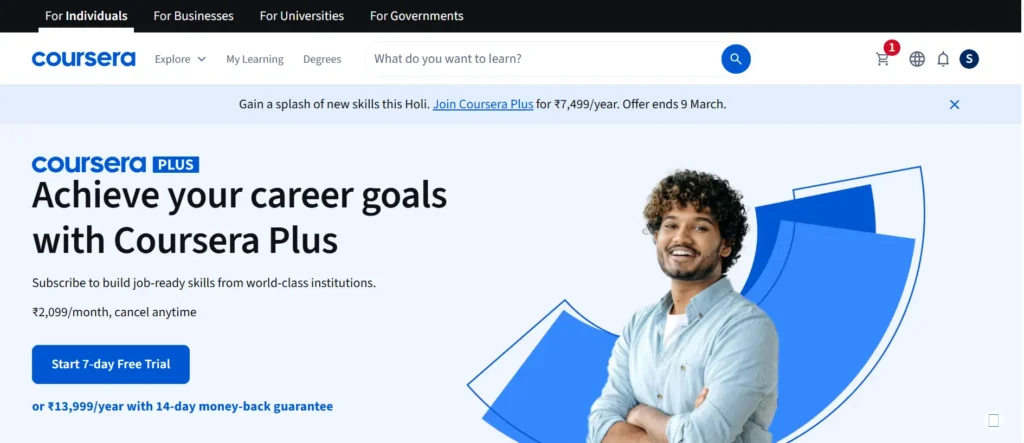
On the other hand, Coursera works mostly on a subscription model. You typically pay $39–$49 per month for a Specialization or Professional Certificate. While Coursera Plus (subscription) costs $59 per month or $399 per year.
For India, Coursera Plus only costs ₹2,099 per month or, ₹13,999 per year.
There is no lifetime access here. If you stop paying, you lose access to the learning material.
Coursera Plus gives access to most programs under a single subscription, but it’s still significantly more expensive than Udemy in the long run.
If budget is your top concern, Udemy clearly wins. If you see learning as an investment in credentials, Coursera starts to make more sense.
Note: Coursera often offers discounts up to 50% off on Coursera Plus subscription – breaking down the annual membership for just $199 per year (or, INR 7,499 for India exclusive). You can subscription to our Newsletter to stay updated.
Who offers better course quality & learning experience?
Now let’s talk about quality — because price doesn’t matter if the content isn’t good.
Udemy courses are created by individual instructors. Some are incredible industry experts who update their courses regularly and focus heavily on practical implementation.
Many Udemy courses are straight-to-the-point. You open the video, follow along, build projects, and learn by doing.
However, quality can vary. Since anyone can publish a course, you need to check ratings and reviews carefully before buying.
Coursera feels more structured and academic. Courses are created by universities and top companies like Google and IBM.
You often get quizzes, peer-reviewed assignments, graded assessments, and sometimes capstone projects. It feels closer to an online university program.
But sometimes that structure also makes it slower and slightly more theoretical compared to Udemy’s fast-paced style.
If you prefer quick, hands-on execution, Udemy feels more practical. If you prefer structured progression and guided learning paths, Coursera feels more complete.
Certification Value: Whose Credential Matters More?
This is where the difference becomes very clear.
Udemy provides a certificate of completion. It shows that you finished the course, but it is not accredited and does not carry strong brand recognition.
Recruiters rarely make decisions based on a Udemy certificate alone. They care more about what you can demonstrate.
On the other side, Coursera certificates, especially Professional Certificates, carry more weight because they are issued by recognized institutions or companies.
For example, a certificate backed by Google or IBM immediately adds credibility to your LinkedIn profile and your resume.
While certificates alone won’t get you hired, a recognizable name can definitely strengthen your resume in competitive markets.
If your goal is skill proof through projects, Udemy works. If your goal is resume credibility, Coursera has the edge.
Job Perspective & Career Impact – Which Can Get You Hired?
Now the real question — which platform helps more with jobs?
Udemy is excellent for learning specific tools or skills quickly. If you want to learn a new AI framework, coding language, or design software, you can start immediately and build projects.
It’s very strong for upskilling and adding practical abilities to your portfolio.
However, Udemy does not usually provide a structured career roadmap. You decide what to learn and how to connect the dots.
Coursera, on the other hand, is built more around career pathways. Many programs are designed specifically for entry-level roles in data analytics, IT support, cybersecurity, and cloud.
These programs follow a sequence. You start from basics and move toward job-ready projects.
If you are switching careers and need structured guidance, Coursera feels more aligned with that goal.
Flexibility & Learning Style – Which Fits You?
Udemy gives you complete flexibility. You can learn at your own speed without worrying about subscription timelines.
Since you own the course forever, there’s no pressure to rush.
Coursera’s subscription model creates a different mindset. Because you are paying monthly, you are more motivated to complete the program faster.
Some learners like that pressure because it keeps them consistent. Others may find it stressful.
Your personality matters here. If you are self-disciplined and exploratory, Udemy works beautifully. If you need structure and deadlines, Coursera may keep you more accountable.
Advantages & Disadvantages of Udemy and Coursera:
Advantages of choosing Udemy:
- Very affordable pricing — Most courses are available for $10–$20 with lifetime access.
- Huge course variety — From AI and coding to productivity and design, almost every skill is covered.
- Strong practical focus — Many courses are hands-on and project-based.
- Learn at your own pace — No deadlines, no subscription pressure if you buy individual courses.
Disadvantages:
- Limited academic depth — Less theoretical foundation compared to university-style programs.
- Quality varies by instructor — Not all courses are equally well-structured or updated.
- Lower certificate value — Certificates are completion-based and not widely recognized.
- No structured career roadmap — You need to plan your own learning path.
Advantages of choosing Coursera:
- High certificate credibility — Programs are backed by universities and companies like Google and IBM.
- Structured learning paths — Ideal for career transitions and guided progression.
- Academic + practical balance — Includes quizzes, assignments, and capstone projects.
- Stronger resume positioning — Recognized credentials can add weight to LinkedIn and CV profiles.
Disadvantages:
- More expensive long-term — Subscription model can add up over time.
- No lifetime access — You lose access once you stop paying.
- Slower pace — Programs can feel more theoretical and less fast-tracked.
- Limited flexibility — Some programs follow timelines and structured schedules.
Final Thoughts: Which One Is Actually Worth It in 2026?
There isn’t a universal winner between Udemy and Coursera — it depends entirely on your goal.
If your main focus is learning practical skills quickly, experimenting with different topics, and keeping costs low, Udemy delivers massive value for the price. You pay once, get lifetime access, and move at your own speed without pressure.
If your goal is structured learning, recognized credentials, and a clearer career pathway, Coursera makes more sense. The programs feel more organized, and certificates from well-known institutions can strengthen your resume.
In simple terms:
- Udemy is skill-first.
- Coursera is credential-first.
The smartest strategy in 2026 might not be choosing one over the other — but using each platform for what it does best.
→ Use Udemy to build skills and projects.
→ Use Coursera to add structured credentials when needed.
At the end of the day, platforms don’t get you hired — skills, proof of work, and consistency do.
Choose the one that aligns with your current stage, your budget, and your career direction.
Now I’d like to hear from you: Got any questions or thoughts about the course? Let me know in the comments.
Happy learning 🙂