

Hey friend,
It’s going to be a few months, I enrolled in CourseCareers Data Analytics course.
And, today I’ll share my complete experience with it…including what worked well, what didn’t, what felt confusing, and what was genuinely useful.
So, if you’re someone looking for CourseCareers Data Analytics review…this guide is for you.
Useful Links First:
Before I dive into my review, here are a few helpful resources related to the CourseCareers Data Analytics program:
- Official CourseCareers Data Analytics course
- 3-free introduction lessons of Data Analytics (no payment cards required)
- CourseCareers free weekly live coaching/workshops
- Referral link to get a $50 off on the CourseCareers Data Analytics
Why I Chose CourseCareers Data Analytics Course?
Before choosing CourseCareers, I did consider other options:
- Google Data Analytics (which I had already taken)
- YouTube tutorials —not structured guide and easy to distract
- Traditional bootcamps — cost over $1000
While Google’s course is taught by Google professionals, I felt the teaching quality varied significantly.
Some instructors explained concepts well, while others struggled to deliver engaging lessons — likely because teaching isn’t their primary role.
Overall, I found Google course solid but honestly, not enough to land a job.
On the other hand, CourseCareers felt different because the entire Data Analytics program is taught by a single instructor — Lukas Halim, a Senior Business Analytics Manager.
His teaching experience is great. You can take a look at its Udemy course on “Tableau for data discovery and visualization” which has praised by many learners.
That’s why I decided to take this course.
Quick Overview of CourseCareers Data Analytics:
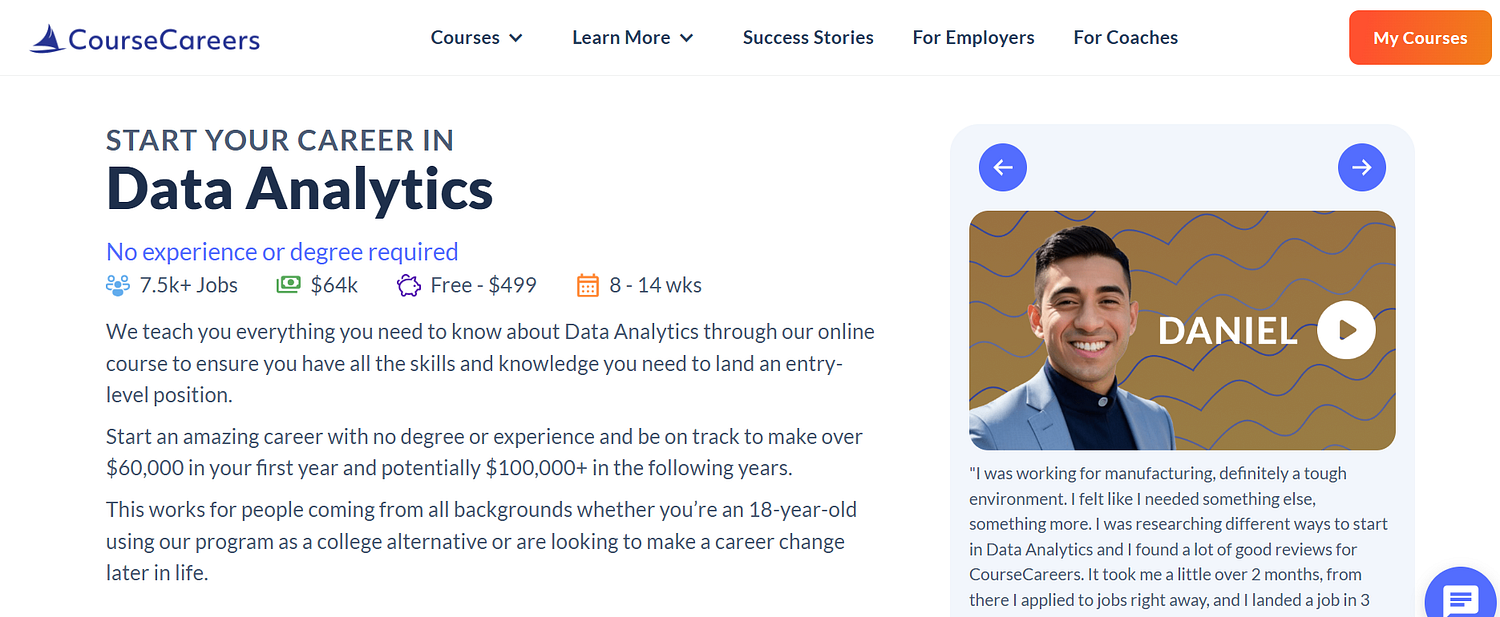
- The CourseCareers Data Analytics program is a compact, job-focused course designed to prepare you for entry-level analytics jobs.
- The course is divided into 6 modules —Introduction, Excel, Tableau, SQL, Python, Interview and Job search.
- This all covers 10 hours of recorded video content, supported by 22 hands-on exercises, 4 portfolio projects, a practice exam, and a proctored final exam.
- While the video duration may seem short, most of the learning happens through exercises and projects rather than passive watching.
- I found it ideal for beginners — perfect to build your foundation in data analytics. No prior experience or programming is required.
- The certification awarded upon completion can be shared on LinkedIn and resumes.
Cost and Duration:
If you check the course on CourseCareers, it costs around $499 when paid upfront, or four bi-weekly payments of $150 if you want to pay in installments.
The bi-weekly payment also cost you $100 extra…but, a good option if you’re on a tight budget.
Btw, by using my referral link you’ll also get a flat $50 off on both payment plans.
You get a 14-day money-back guarantee in case you don’t find the course worth. And, trust me, it’s refund actually works…I’ve seen many good reviews about its refund.
Also, you get a lifetime access with the course material and free workshops which you can take whenever you want.
Let’s talk about duration:
On CourseCareers dashboard, you’ll see the avg. time to complete the program in 8–14 weeks, depending on your pace.
However, I think it doesn’t matter much as there’s no recurring subscription pressure, you can move slower if needed without worrying about additional cost.
My Review — CourseCareers Data Analytics Course
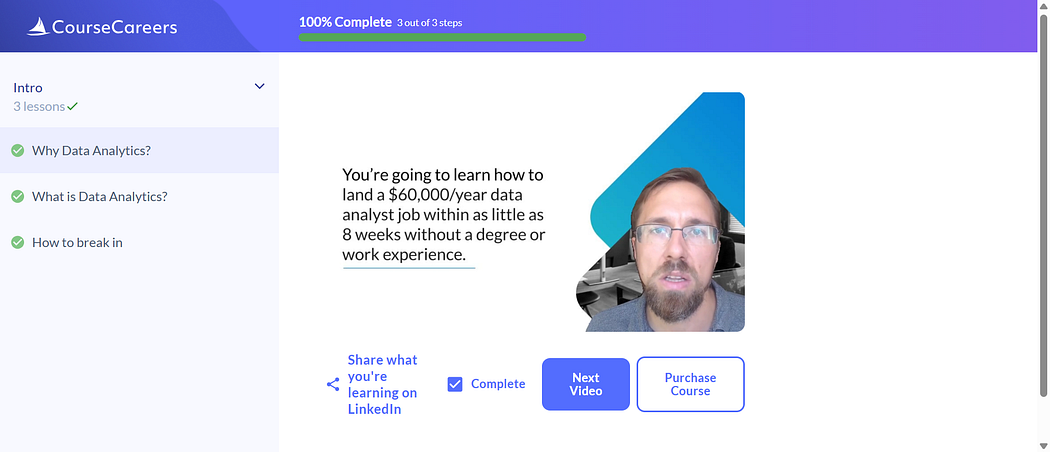
Before purchasing the course, I took its first 3 introductory lessons — which is more about giving you an overview of data analytics industry and career in it.
However, when it comes to to main content, I found it to be a linear and structured learning path, where each module builds logically on the previous one.
The learning approach is also straightforward: video explanation then guided exercises and project-based application next.
What I different in it is clarity of instruction. Since the entire program is taught by a single instructor, the teaching style remains consistent throughout.
Also, the course focuses a strong emphasis on practical application over theory. Concepts are explained only to the extent necessary to perform real-world tasks.
This makes the learning process feel efficient and job-oriented, which is great if you don’t like theoretical lectures.
The pace of the course is manageable for beginners. Early modules are easy to follow and focus on building confidence, while later sections introduce more complexity through SQL querying, dashboard creation, and Python-based analysis.
That said, you may also feel that certain topics move quickly, especially if they are completely new to analytical thinking.
You’ll be also asked to connect with CourseCareers Discord community and weekly live sessions, which provide opportunities to ask questions and get clarification.
This interaction makes the learning experience feel more guided as compared to fully self-paced courses.
What I Learned Across the Entire Program:
Now, let me share my learnings from CourseCareers data analytics course.
The course is divided into 5 modules — Introduction, Excel, Tableau, SQL, Python, Interview and Job search.
Here is what I’ve learned and you may expect with this modules:
1. Introduction & Analytics Foundations
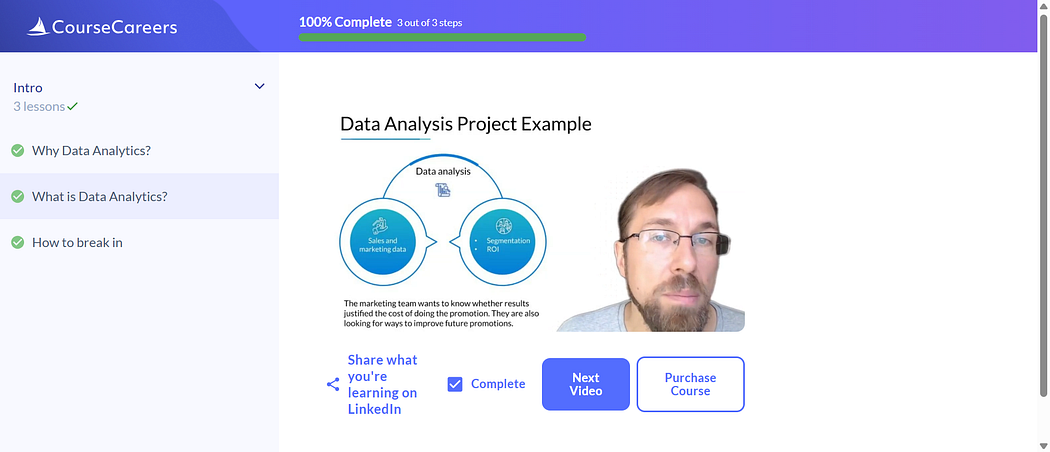
The introductory module does not start with tools or formulas. Instead, it focuses on how data analytics works in a real business setting and what employers can actually expect from an entry-level analyst.
What I found valuable here was the clarity it provided around roles, responsibilities, and expectations. The course explains the difference between data analytics and data science early on, which helps avoid unrealistic assumptions.
From a learning perspective, this module helped me shift from thinking about just “learning tools” to solving business problems using data.
2. Excel
The Excel module reinforces why spreadsheets are still one of the most important tools in analytics roles. Rather than treating Excel as basic or outdated, the course shows how it is actively used for cleaning, analyzing, and summarizing data in real work environments.
Through this module, I became more comfortable with:
- Structuring datasets properly
- Using formulas and functions efficiently
- Working with pivot tables and charts
The project using box office data was especially useful because it felt practical and realistic. It helped me understand how Excel is often used as a first layer of analysis before moving to more advanced tools.
Overall, this module builds confidence quickly and makes Excel feel like a powerful analytical tool rather than just a spreadsheet program.
3. Tableau
This one is one of the strongest parts of the course. It goes beyond teaching how to create charts and instead focuses on communicating insights through visualization.
Through hands-on practice, I learned how to:
- Connect and prepare datasets
- Choose appropriate chart types
- Build dashboards that tell a clear story
The Covid-19 food and beverage analysis project stood out because it demonstrated how visualization supports decision-making, not just presentation.
By the end of this section, you will feel more confident in explaining insights visually, which is a critical skill for analytics roles.
4. SQL
In this module you’ll learn about database querying. It starts with basic queries and gradually builds up to more complex concepts like joins, subqueries, and window functions.
What I gained from this module was a functional understanding of how analysts interact with databases. Writing SQL queries stopped feeling intimidating and became more logical with practice.
The final project analyzing U.S. personal consumption data helped tie everything together. It showed how SQL is used to extract meaningful insights from large datasets, rather than just retrieving data.
While the module does not go deep into advanced SQL optimization or performance tuning, it provides a solid foundation that aligns well with entry-level job requirements.
5. Python
Python is introduced as a supporting analytics tool rather than a primary focus. The module covers basic syntax, working with data, and simple visualizations using Matplotlib.
From a learning standpoint, this section helped me:
- Understand where Python fits into analytics workflows
- Get comfortable reading and writing simple Python code
- See how Python complements tools like Excel and SQL
This module does not aim to make you proficient in Python, but it does reduce the fear of programming. It creates a starting point from which you can confidently continue learning Python on your own.
6. Interview Preparation & Job Search
The final module shifts focus from technical skills to career readiness. It covers resume building, LinkedIn optimization, interview preparation, and general job-search strategies.
What I found helpful here was the emphasis on how to present yourself as an entry-level analyst, even without prior work experience. The guidance around framing projects and explaining skills in interviews adds practical value.
While this module does not guarantee job placement, it provides direction and structure, which is useful if you are new to the job market or switching careers.
>> Explore CourseCareers Data Analytics Course (Modules)
My View on Overall Learning:
In my view, the overall learning progression across modules feels logical and well-organized.
Each tool builds on the previous one, and the repeated emphasis on business context helps connect technical skills to real-world applications.
Although some areas could go deeper, the program succeeds in creating confidence, clarity, and practical readiness…which is exactly what a beginner-focused analytics course should aim for.
Now…let me share the good and bad part of Coursera Data Analytics course that you may also experience in it.
The Good (What CourseCareers Did Well)
- One of the strongest aspects of the CourseCareers Data Analytics is its clear focus on job readiness.
- The curriculum avoids unnecessary theory and instead focuses on skills that are actually expected in entry-level analytics roles.
- The consistent teaching style throughout the program makes learning smoother and more cohesive. Having a single instructor improves clarity and reduces confusion.
- The program is also beginner-friendly. Concepts are explained in plain language, and the practical exercises help build confidence quickly. The inclusion of portfolio projects adds tangible value for learners looking to showcase their skills.
- Additionally, the community support and lifetime access to course material add a layer of accountability and guidance that other courses lack.
The Bad (What I Didn’t Like)
- The program’s strength in simplicity can also be a limitation. Some topics are covered at a surface level, which may leave you underprepared for more complex real-world scenarios.
- There is limited exposure to messy, unstructured data and real-world challenges such as environment setup, version control, or ambiguous business requirements. These are skills you’ll need to develop independently.
- While Python and SQL are introduced, they are not explored in depth. If you’re aiming for more advanced analytics or data science roles will need additional learning beyond this program.
CourseCareers Certificate Value – Can You Get a Job After the Course?
After passing your final exam, you’ll be liable to earn a Course of Completion Certificate from CourseCareers.
But, does it help you to standout in the competition or get recognized by potential employers?
Honestly, I don’t think. Let me explain:
Adding the certificate to your resume and LinkedIn profile can help demonstrate your intent and seriousness, especially if you are transitioning into analytics from a non-technical or unrelated background.
In my view, the real value of the CourseCareers program is not the certificate itself, but the practical clarity it provides.
By the end of the course, analytics stops feeling like an abstract concept and becomes a tangible role with defined tools, workflows, and expectations.
Regarding job outcomes, CourseCareers does offer career support in the final stage of the program. There are also hiring partner, but standing out requires strong performance in the final exam and genuine understanding of the material.
That said, completing the course does not guarantee a job. Whether you land a role depends largely on:
- How well you understand and apply the skills taught
- The quality of your portfolio projects
- Your ability to explain your work in interviews
- Consistent practice beyond the course material
On a personal level, the program improves confidence and direction. It helps you understand what entry-level data analyst roles actually require.
Final Thoughts — Is CourseCareers Data Analytics Worth the Investment?
Now…let me put my final verdict.
If you are beginner in data analytics, completing the CourseCareers Data Analytics course will may feel like a practical first step to build a solid foundation.
The course largely met my expectations by offering a clear, job-oriented introduction rather than an theoretical lectures.
What stood out most was the focus on real-world tools and workflows.
While the program teaches with clean datasets and structured tasks, actual analytics jobs often involve around complex requirements and messy data. Recognizing these gaps early is valuable and sets realistic expectations.
Who will get the most value:
This course is particularly well-suited for:
- Beginners with little or no prior analytics experience
- Learners from non-technical backgrounds
- Those seeking a clear roadmap into entry-level data analytics
- Individuals who prefer structured, practical learning over theory-heavy course.
Who might feel disappointed:
The program may feel limited if:
- You already have strong experience with SQL, Python, or analytics tools
- You are looking for advanced data science or machine learning depth
- You expect guaranteed job placement or immediate hiring outcomes
In this case, I’d recommend you to take Google Advance Data Analytics Course on Coursera.
My suggestion:
I would recommend the CourseCareers Data Analytics course as a launchpad rather than a final destination.
It provides a solid foundation, practical exposure, and career clarity…but further learning and independent practice are necessary to grow beyond entry-level roles.
My advice is to:
- Take the course at a steady pace
- Focus on truly understanding the concepts, not just completing modules
- Strengthen your portfolio beyond the provided projects
- Continue learning through real datasets and personal projects
The course lays the groundwork. What you build on top of it will determine how far you go.
Now It’s Your Turn:
If you have any questions about the CourseCareers Data Analytics course or a career in data analytics, feel free to ask beloew in the comments.
If you’re planning to enroll, you can use my referral link to get $50 off the course price. It will also help me earn a small referral commission 🙂
Happy learning 🙂


I really appreciate this well-written and informative blog. It not only compares CourseCareers with Google’s program thoughtfully, but also highlights the real-world value of hands-on learning and job-focused support. The breakdown of each module, the focus on in-demand tools, and the clarity in explaining the career path make it a great guide for anyone starting out in data analytics.
Thank you so much for the kind words! I’m glad you found the comparison and insights helpful. Wishing you all the best on your data analytics journey!