
(Disclaimer: To keep our blog ads-free, we may use affiliate links in the post. Rest assured, they don’t affect our reviews.)
Hey friend,
I recently completed the IBM Data Science Professional Certificate on Coursera, and in this post, I’m sharing my complete experience and review – the good, the bad, and the reality of what you actually learn.
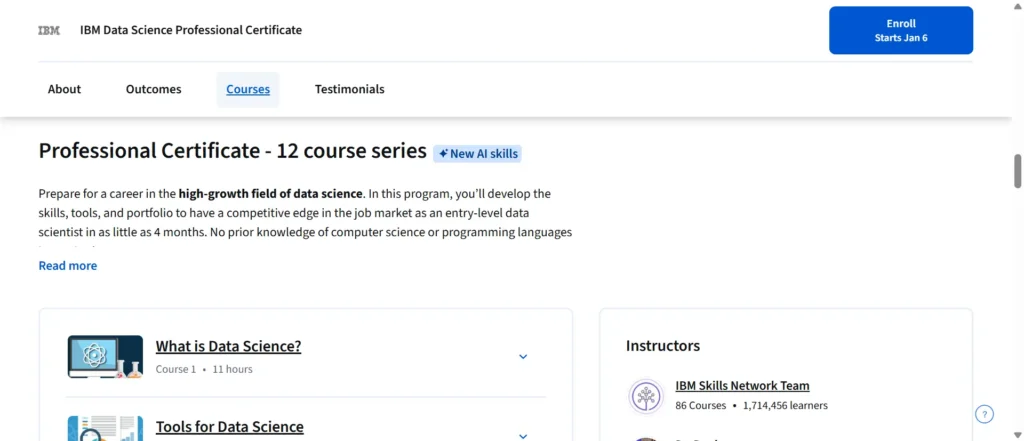
If you’re considering this course, you should expect a well-structured 12-course series learning path that covers the most relevant fundamentals of data science.
Before I dive into my review, I want to clarify, this is not a promotional article. It’s based entirely on my experience after finishing the program, and I genuinely recommend it as a starting point for anyone entering data science.
If you’re short on time, feel free to jump directly to the point 8. Final Thoughts section for my verdict.
A Few Useful Links:
Below are some useful links to help you find the Data Science course on Coursera, view the certificate I earned after completing the course, access the IBM Skills Network / Labs platform, and explore the GitHub repositories and projects I worked on.
- IBM Data Science Professional Certificate (Coursera)
https://www.coursera.org/professional-certificates/ibm-data-science - My Final Certificate
https://coursera.org/share/c80127360edca7fae2aef244fb326a9e - IBM Skills Network / Labs Platform
https://labs.cognitiveclass.ai/non-portal - My GitHub Repositories & Projects
https://github.com/Ndoloh?tab=repositories
My Background & Learning Goals
I come from a technical background as a Computer Science student. I was introduced to computers and programming when I joined campus, starting my journey with C++ through game development…but, later fell in love with Python, R and SQL.
My interest in Data Science developed after I left college and began searching for clarity. Even without a formal degree, I wanted to stay actively involved in science and computing through skill-based learning.
At the time, I enrolled in IBM Data Science Professional certificate, I had no prior experience in data science beyond writing just basic Python, R, and SQL scripts, which I had learned during my two-and-a-half years on campus.
Why I Chose IBM Data Science Professional Certificate
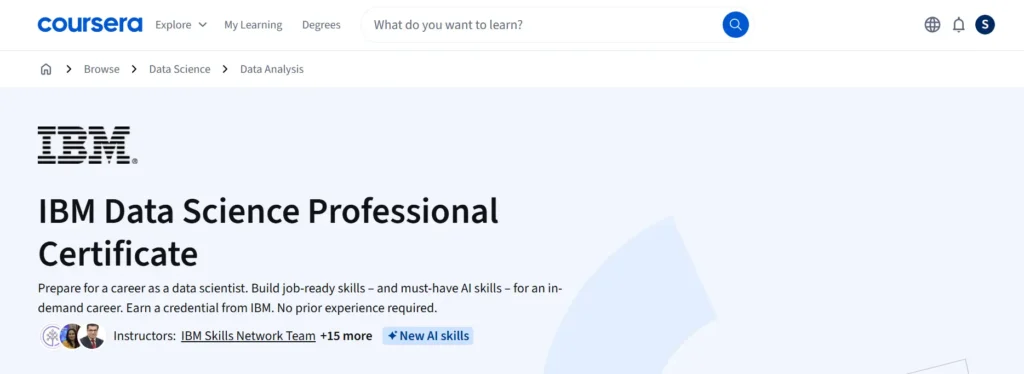
As a campus dropout, one of my biggest challenges was the absence of a professional credential beyond secondary education.
I was looking for a certification that could help me land an employment opportunity or get freelancing roles. I also wanted a certificate that stood out from the rest.
I had an option for other certifications such as; Udemy, You Tube, Google and bootcamps but preferred the one from IBM because it is skill based and could also be recognized by different employers within the Data Science field.
Quick Overview of the Course
- The IBM Data Science Professional Certificate consists of 12 courses, each courses focusing on a specific data science topic.
- The whole course places strong emphasis on Python and SQL, with R introduced at a foundational level.
- Throughout the course, you work with widely used libraries such as Pandas, NumPy, Matplotlib, Seaborn, Scikit-learn, and Folium.
- In addition to programming, the course covers key methodologies including data analysis, data visualization, statistical analysis, data wrangling, and introductory machine learning (supervised and unsupervised).
- Lastly, platforms such as Jupyter Notebooks, IBM Watson Studio, IBM Cloud, and GitHub are also taught.
- In my view, the course is ideal for anyone who is interested in learning Data Science. No prior skill of programming experience is required as everything is taught from scratch. The lab practices and question assignments also improves your understanding of the concepts within the course material.
- The certification awarded after the completion of the course is digitally shareable via Coursera and Credly.
Pricing:
The course follows a subscription model and costs approximately $20 per month. The longer you take to complete the course, the more you’ll end up paying.
Alternatively, you can access the course through a Coursera Plus subscription, which costs $59 per month or $399 per year.
Please note that both the course subscription price and Coursera Plus pricing may vary depending on your location. Since I don’t have Coursera Plus, I purchased a 3-month course subscription.
Duration:
At a recommended pace of 4-5 hours per week, the course material is estimated to be finished in a span of 3-6 months. I completed the course in a period of 3 months as a full-time commitment.
The completion time depends on the prior experience with the topics and weekly hours dedicated to learning.
Course Structure & My Learning Experience:
The course follows a linear structure, with each module building upon the previous one.
There is a short video about a topic, an ending quiz and hands-on lab to build off the practical aspect. This method of course presentation makes the “learn, test, apply” cycle works well.
One of the strongest aspects of the program is the IBM Skills Network Labs. These are cloud-based Jupyter notebooks that run directly in the browser. There is no installation required to run the cloud-based Jupyter notebooks there by making them easy to run and work with. This significantly reduces technical barriers and allows learners to focus on understanding concepts rather than configuring environments.
The pace of the course is generally manageable. Early modules are easy to follow, while later sections introduce more complexity, particularly during the machine learning modules and the final capstone project. The hands-on, lab-centric approach helps solidify understanding and keeps the learning experience engaging.
Some of the later modules, especially those introducing IBM Watson tools, felt rushed and more of a product overview rather than learning focused.
What I Learned Across the Entire Course:
Here, I won’t go through all 12 courses one by one. Instead, I’ll break down what I learned across the entire program. This won’t feel repetitive and long, perfect if you just want insights, not a detailed syllabus walkthrough.
1. Foundations & Mindset
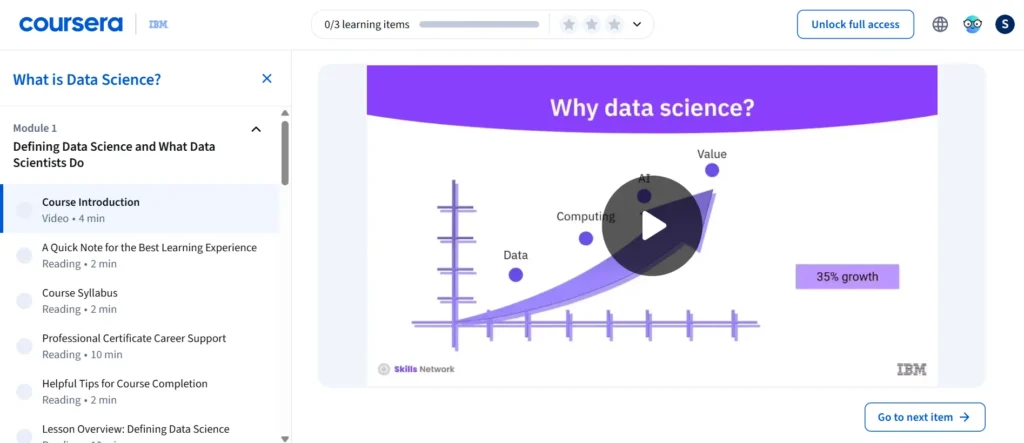
Coding is not for everyone and when mentioned some might be scared. The program opens not with a code but by a basic storytelling of what is the role of a data scientist – from both a business and technical point of view.
In my case, this was very inspirational and informative. This context is important in keeping a complete beginner oriented, but it might seem a bit surface-level up to the point when the technicality starts.
2. Programming & Tools
This is the core strength of the program…where you build a concrete and working background in Python (Pandas, NumPy), R and SQL fully inside Jupyter notebooks on the IBM Skills Network Labs.
The ease of entry is great, the start-to-code experience is also smooth and with the in-built labs, there is no need to install anything before you start coding.
The program prioritizes practical application over heavy theory, which helps build confidence quickly. While theoretical explanations are limited, they are sufficient to support the tasks and exercises.
3. Data Analysis & Visualization
At this particular point, the learning by doing shines! You work on cleaning and wrangling data, performing exploratory analysis, and building visualizations using Matplotlib, Seaborn, and Folium.
Working with realistic datasets makes the experience engaging and helps you understand not just how to visualize data, but why certain visualization techniques are chosen for specific problems.
By the end of this part, you develop the understanding of taking a dataset and telling a coherent story that is informative for the decision making process.
4. Machine Learning: Expectations vs Reality
This is the most critical evaluation point. The course presents the most important concepts of machine learning (supervised/unsupervised, regression, classification, clustering) and takes you through the process of applying algorithms using Scikit-learn.
Honesty, this provides just an important introduction but does not dig deep into the topic. In this part, you are taught how to apply models properly in a supervised context but not how to tune them or work with very messy data.
This makes you ready to do simple Machine Learning work but not to do more complex, real-world modeling which requires that you dig deep into further studies to understand real-world modelling.
5. Projects, Labs & Capstone Experience
The building of labs and auto-graded projects is a successful way of developing competency. The capstone project, which involves picking a problem, data analysis, model creation and presentation, is truly worthwhile as it makes you integrate everything. The project is portfolio worthy, and it is tangible evidence of the acquired skills.
6. Overall Progression & Difficulty Curve
The presentation of the course material is logical and sequential. It has a certain amount of intentional repetition (such as going back to Pandas in different situations), and this helps in learning rather than causing confusion.
Even though the jump into machine learning is steeper, the program does a respectable job of bridging the gap between data extraction and analysis up to the modeling, creating a logical introduction to machine learning as a beginner.
The Good (What IBM Did Well):
- One of the strongest aspects of the IBM Data Science Professional Certificate is its clear and structured learning path. As a learner, you never feel lost or unsure about what comes next. Each course builds naturally on the previous one, creating a strong foundation for beginners.
- The course is also highly beginner-friendly. Complex topics are broken down into digestible explanations using plain language. The initial introduction to coding, especially through the cloud-based labs, helps reduce the fear often associated with programming.
- The hands-on exposure makes the program’s greatest strength. The IBM Skills Network Labs provide an opportunity to apply all the theoretical concepts through coding, analysis, and visualization. This practical approach helps develop muscle memory and genuine confidence.
- The difficulty curve is also well-designed, gradually taking you from basic Python operations to building and evaluating machine learning models in a logical sequence.
The Bad (What I Didn’t Like):
- The program relies heavily on pre-configured labs, which makes it easy for beginners to get started with programming. However, this creates a gap between lab exercises and real-world job requirements. You don’t gain hands-on experience in setting up a local Python environment, managing library versions, or handling messy data from unreliable APIs – all of which are critical in real-world jobs.
- For me, some sections of the course feel outdated and overly simplified, particularly those focused on the company’s proprietary tools (such as Watson Studio AutoAI). These parts often come across more like product demonstrations than long-term learning experiences.
- Although the machine learning modules provide a basic introduction, they oversimplify key processes like model evaluation and hyperparameter tuning. This can create a false sense of confidence and underestimate the real-world complexity of applying machine learning in professional environments.
Certificate Value & Career Impact:
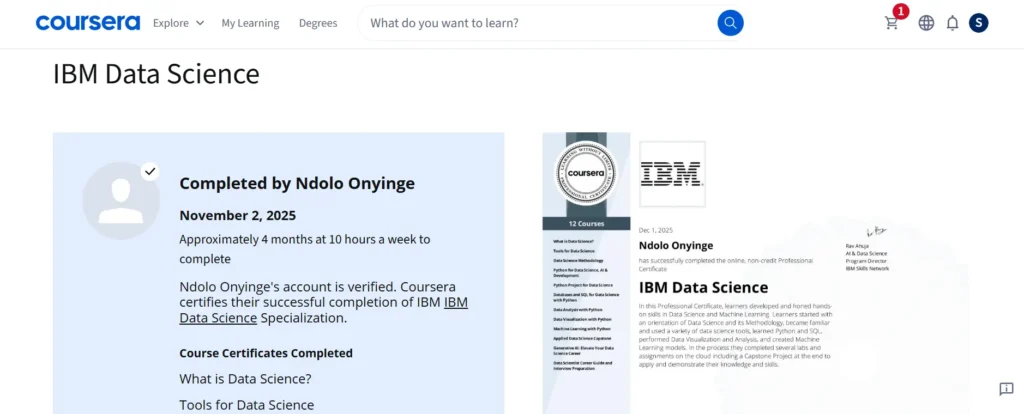
The course certificate serves as an effective indicator of dedication and base level skill development. Adding the certificate to your resume and LinkedIn makes it more visible, and could get you through first screening filters, particularly in an entry level role.
From my perspective, recruiters are aware of the IBM brand and respect it. It proves that you have gone through a rigorous, practical program, but is rightly considered as a groundwork course, rather than a senior course.
On a personal impact, it has developed my confidence and clarity. Despite the fact that I am currently not in any role as a data scientist, overall participation in the program has made me more brave and pragmatic. It transformed a field that was more of an abstract concept to a practical career that I am now ready to take up.
Final Thoughts: Is IBM Data Science Professional Certificate Worth It?
Completing IBM Data Science certificate was one of the very first steps that has given me a stepping stone to the field of Data Science.
It largely felt in line with my expectations by offering a formal, practical introduction to data science. The most surprising experience was the practical confidence acquired during the applied labs.
Another thing that surprised me was the difference between the clean lab setting and the reality of data scientist workflow that is more messy.
Who is this course best for?
This certificate is an excellent option for beginners – who is just getting started, or have a non-technical background and requires a well-organized roadmap of zero to be competent in data science. It makes the field less complicated and helps in the development of practical competence.
Who might feel disappointed?
Some of the initial parts of the course will be redundant to you in case you have already worked with Python and data analysis. The curriculum can be too introductory to those who want more profound, sophisticated machine learning or a job-placement promise.
My Suggestion:
I will strongly recommend this certificate as a launchpad. The certificate is an investment worth making to the determined beginners.
My advice is that when you take the course, move at a consistent pace to contain the cost, do the projects to develop your portfolio, and consider taking more advanced and specialized courses later on. This certificate lays the foundation – the rest of the journey is up to you.
>> Explore IBM Data Science Professional Certificate
Happy learning 🙂
About the Author
Hey, I am Ndolo Moses Onyinge, a Technology Enthusiast and an aspiring Data Scientist, building a career through professional certifications and hands-on projects.